
About the project
A PLANETARY LANDMARK FOR THE CLIMATE AGE
Climate is no longer an abstract idea or a distant threat. It is the system of relationships—between atmosphere, water, soils, living beings, infrastructures, and economies—that determines whether societies can endure and prosper over time. Today, this system is already shaping how cities function, how land is produced, how food is grown, and how value is created. Rotterdam, like many places around the world, is already operating inside this reality.
At a moment of tangible climatic disruption, the role of a Climate Landmark is to restore agency and the capacity to act together. The challenge today is not whether climate matters, but how it can be made present, legible, and useful for everyday decision-making—by communities, institutions, and enterprises alike. Resetting climate is therefore pragmatic, not apocalyptic. It means reconstructing the alliances between human and more-than-human life, and accelerating the transition from an era shaped by carbonization and extraction toward one grounded in regeneration, mutual care, and long-term viability.
Because climate is a system of relationships, it must be addressed where those relationships actually take place. More than 90% of the interactions that determine climate occur in what scientists call the Critical Zone: the thin yet immensely consequential layer extending from deep soils and aquifers up to the lower atmosphere. This is where geology, water, biology, agriculture, cities, and infrastructure intersect. It is where climate is produced—and where it can be changed. A Climate Landmark that does not actively engage the Critical Zone risks remaining symbolic rather than effective.
Rotterdam offers an exceptional context for this approach. The city itself is a constructed section of the Critical Zone. Meltwater from the Alps travels through the Rhine Valley, carrying sediments accumulated over millennia. These materials were engineered, drained, stabilized, and transformed through centuries of human intervention, producing not only land, but one of the central nodes of global trade and material circulation. Climate, geology, and enterprise are inseparable here. Rotterdam’s success has long depended on understanding climate not as an obstacle, but as a condition to work within intelligently.
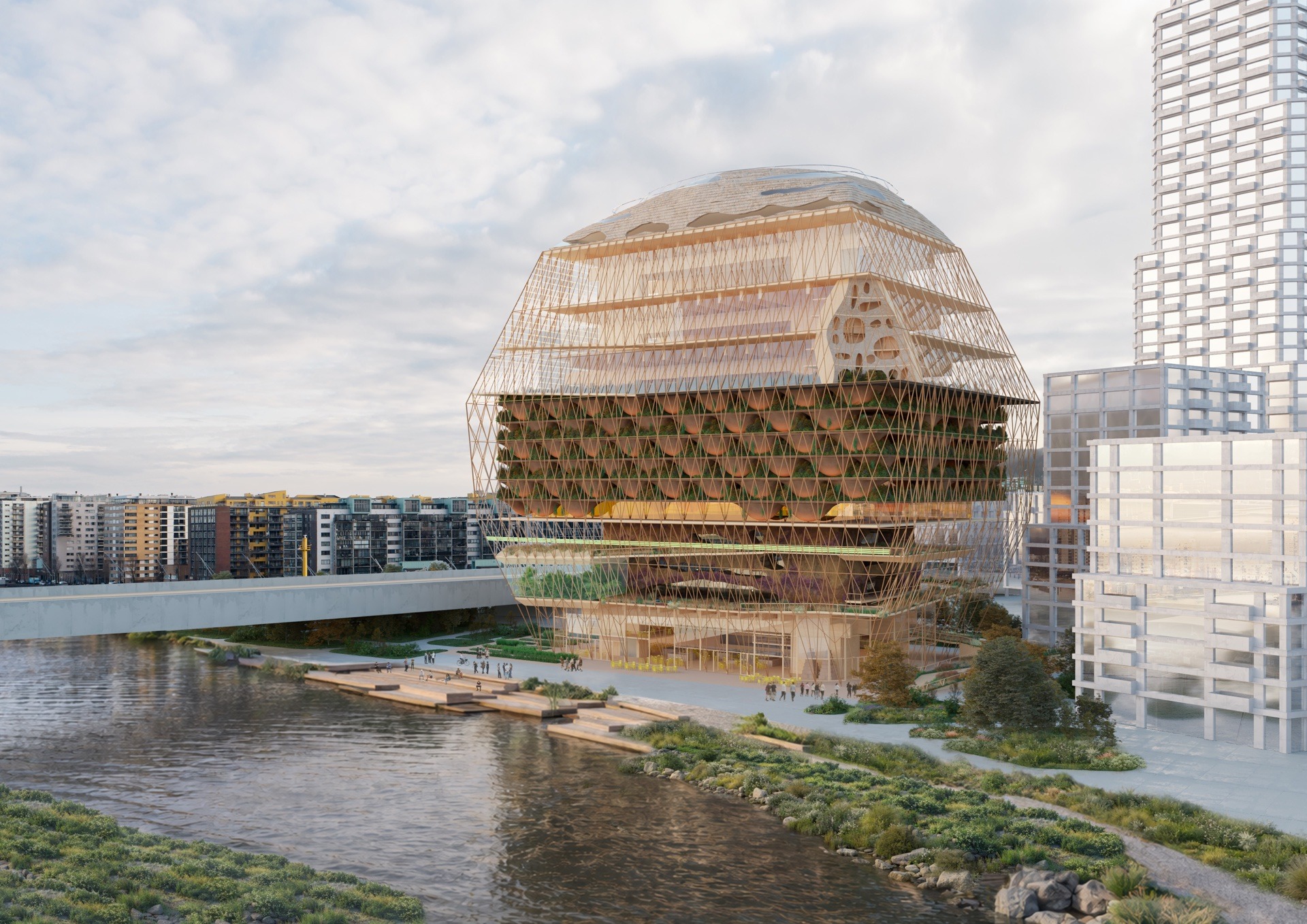
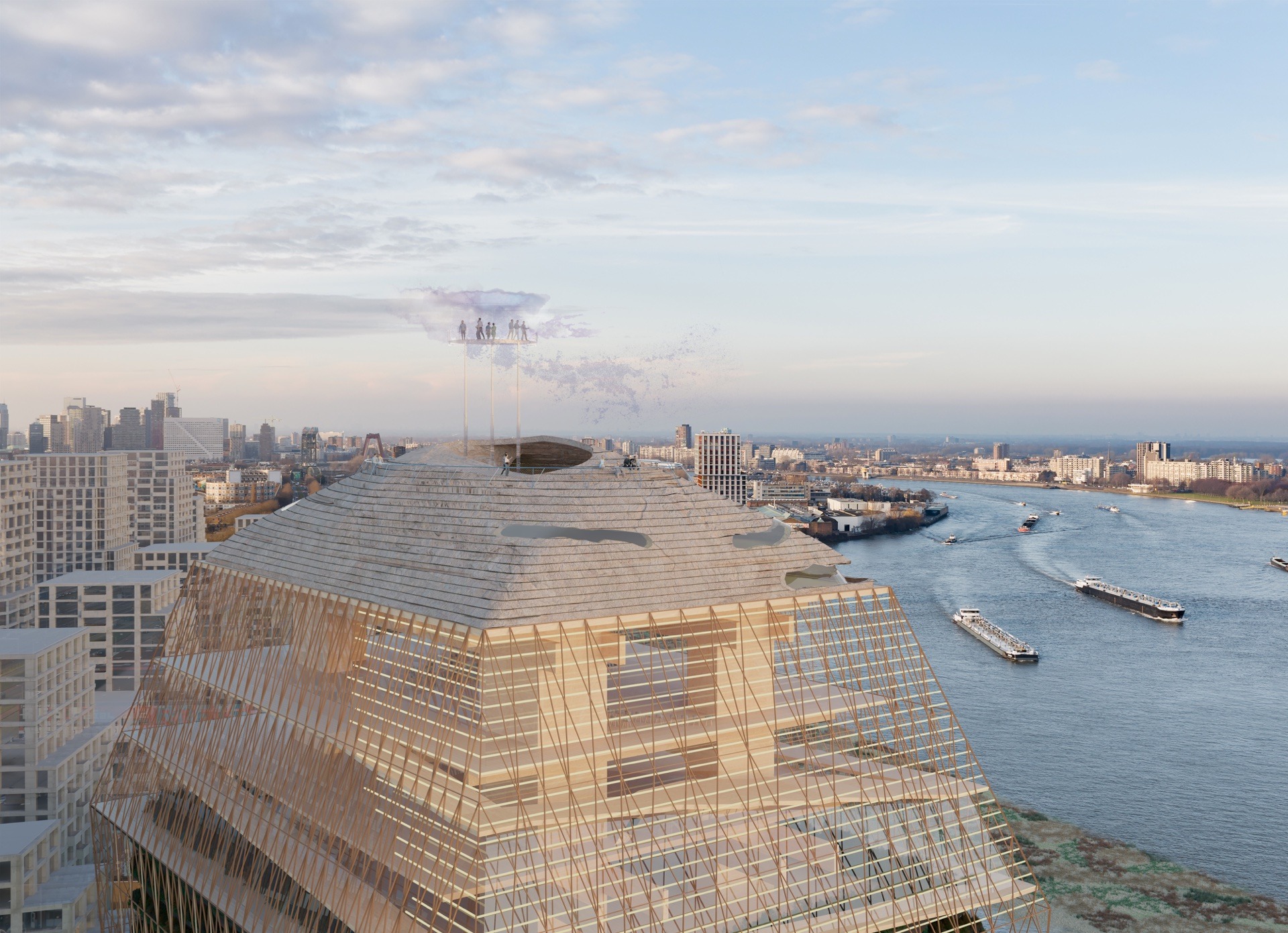
Climate Section builds directly on this legacy. It is not conceived as a conventional building, but as a vertical, inhabitable cross-section of the Critical Zone itself. From mineral layers to coastal systems, from urban and industrial processes to air and atmosphere, Climate Section allows people to move physically through the systems where climate happens. Climate is not observed from a distance; it is inhabited. This transforms climate from an abstract concern into a lived, actionable reality.
Climate Section functions as a live and connected Climate Navigation Deck for the Climate Age. Rather than hosting a fixed exhibition, it operates as a continuously updated platform that links Rotterdam to distant territories—glaciers, soils, deltas, and infrastructures—through real-time sensing and data exchange. A clear precedent for this approach is Italian Limes by Studio Folder, partners in our team, where sensors installed along the Alpine border between Italy and Austria track the shifting watershed as glaciers melt, causing the national boundary itself to move in real time. Climate Section extends this logic by making climate change legible as a shared condition, and action a matter of informed navigation rather than abstract response.
At the same time, Climate Section is an inhabitable alternative—a prototype of a climate-affirming way of life. It brings together the communities of Rotterdam South and the wider city with scientists, artists, entrepreneurs, policymakers, and civic organizations. Not to debate climate in isolation, but to build shared capacities through everyday experience. Visitors eat differently, breathe differently, rest differently, and observe differently. Climate action becomes tangible because it is lived.
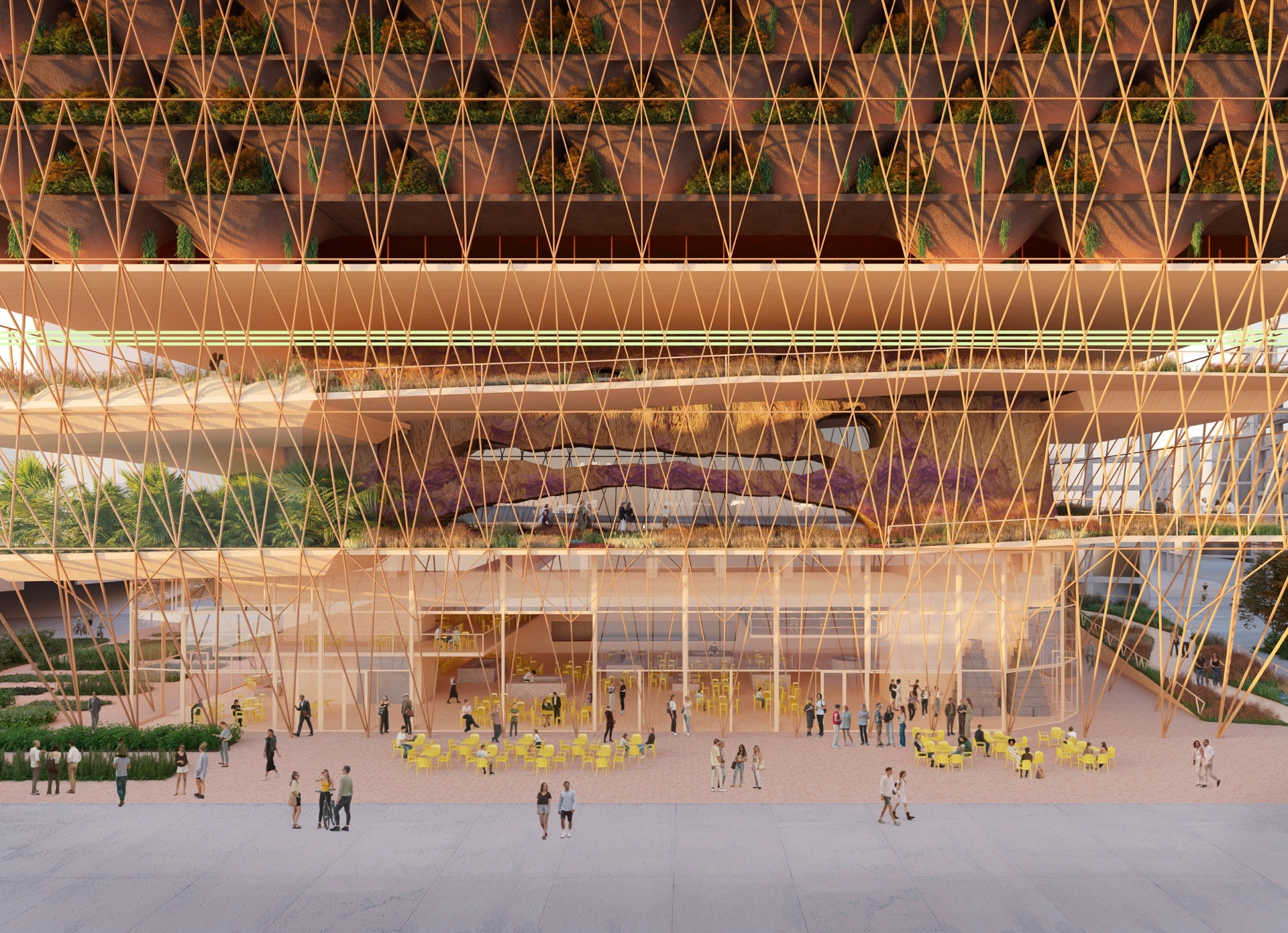
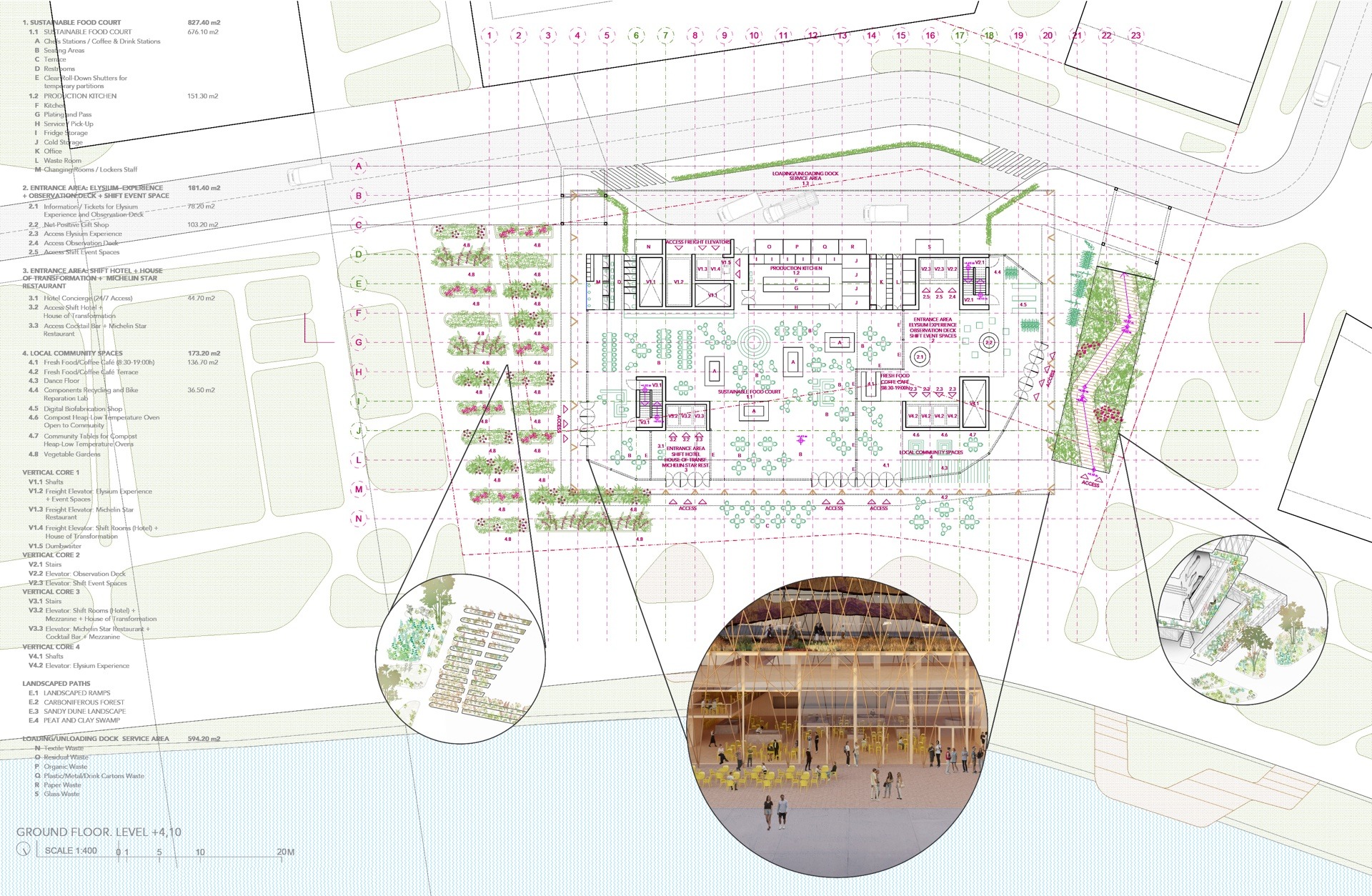
The project is designed to generate eco-social abundance, not merely reduce harm. At ground level, geothermal energy supports a climate-controlled public square: a place for cafés, celebrations, bicycle workshops, cultural events, and daily gatherings. Hospitality and social life are integral to the project’s economic and civic viability.
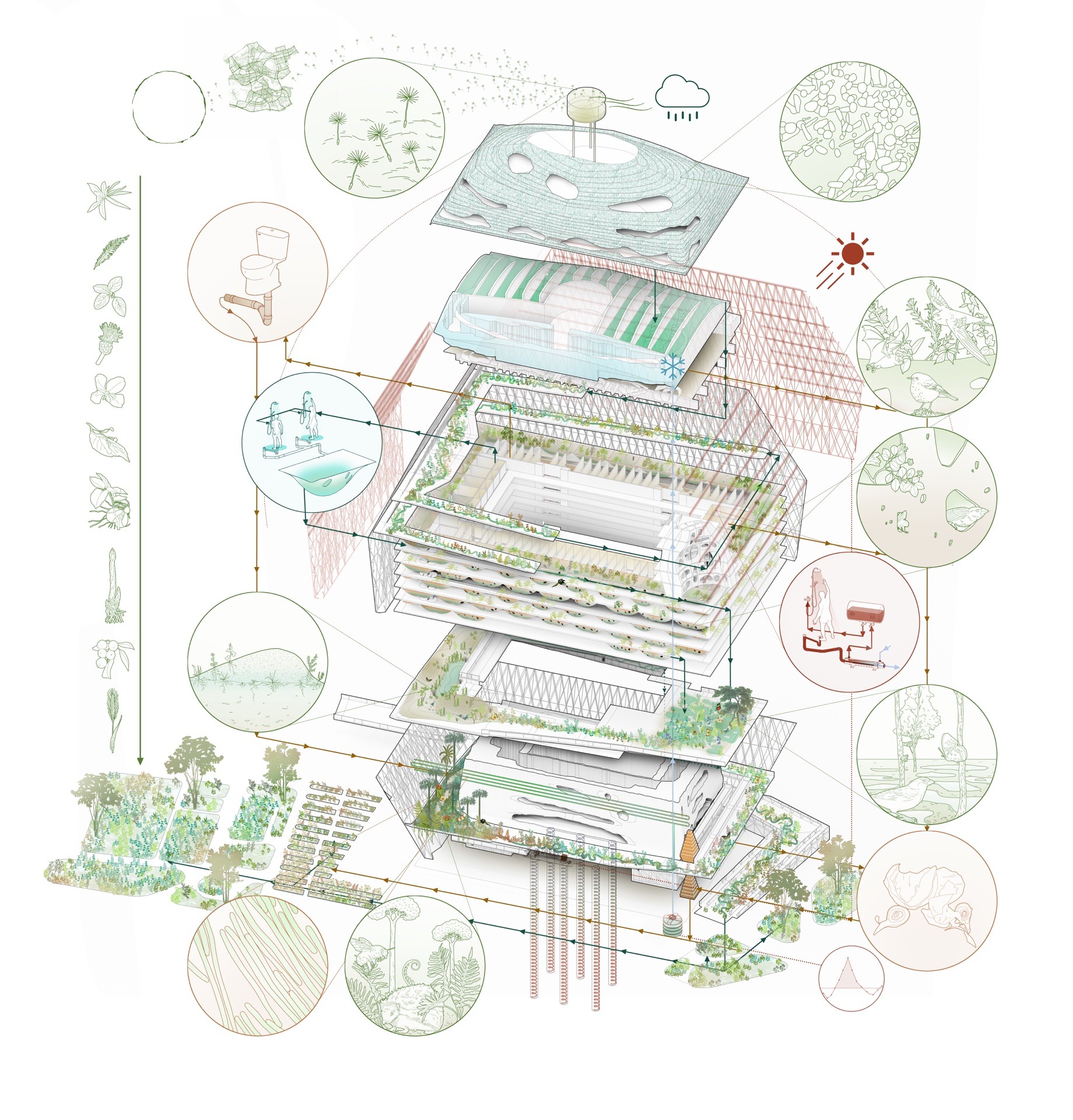
Water, energy, and soil are treated as shared assets. Rainwater and greywater are collected, filtered through planted landscapes, and reused. Energy is produced through geothermal systems and building-integrated photovoltaics. Organic waste is composted and transformed into fertilizer, turning Climate Section and its surroundings into a center of fertility and biodiversity. At its upper levels, seeds are released into the air, linking the experience of ascent to regeneration beyond the site.
Finally, Climate Section is conceived as an infrastructure of more-than-human mutual care. It is not designed only for humans, but as a shared environment for plants, fungi, insects, birds, and microorganisms. Habitats are integrated throughout the structure, and even the hotel becomes a space of transspecies coexistence.
Climate Section proposes a new kind of landmark for the Climate Age: not a monument, but a working section through the world as it is becoming—a place where climate is sensed, understood, and actively reshaped, together.
01 — A LANDMARK THAT IS A SECTION THROUGH CLIMATE
This landmark is not placed next to climate. It is a section through the systems where climate is produced—and where it can be changed.
The Climate Section is a living infrastructure that brings together the interacting systems that shape climate: geology and soils, groundwater and oceans, living organisms from microbes to humans, urban and infrastructural systems, and the lower atmosphere. These systems are not represented; they are present and active.
The project is grounded in Earth-system science and the concept of the Critical Zone—the thin layer from deep soils and aquifers to the lower atmosphere where most climate-shaping interactions occur. By cutting vertically through this zone, the Climate Section makes climate spatially legible, physically experienced, and open to intervention.
This is not an exhibition. It is an operational environment—a place to understand and reshape climate from within.
Welcome to the Climate Section.
02 — ROTTERDAM’S GATEWAY TO THE TIDAL PARK: A PLACE TO KEEP COMING BACK TO
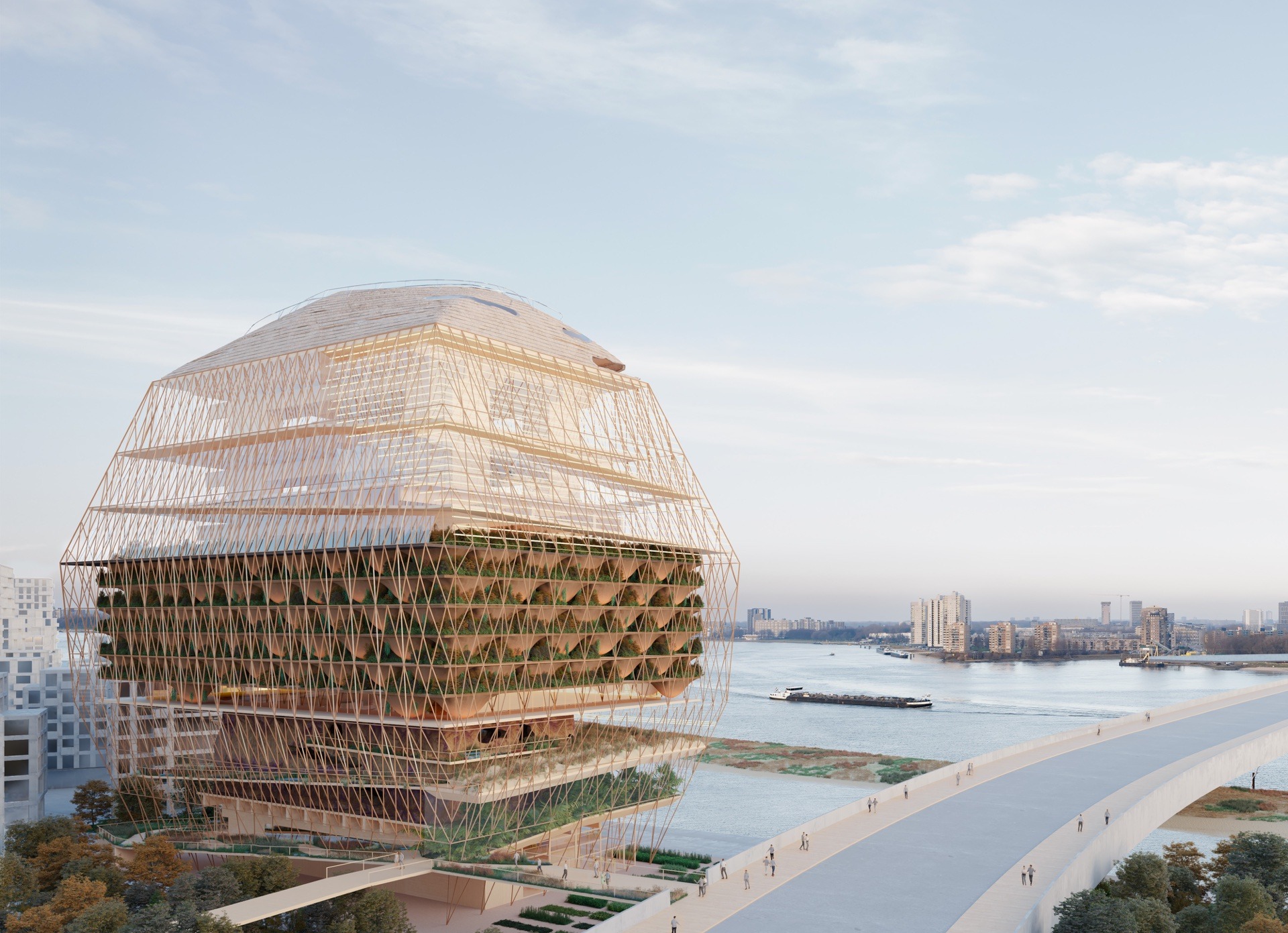
Climate has become a fundamental part of the civic domain. The SHIFT Landmark is therefore conceived first and foremost as an extension of public space—a new gateway to the Climate Age. It connects the bridge linking Rotterdam South and North with the tidal and promenade parks through a landscaped, elevated passage that transforms movement into experience.
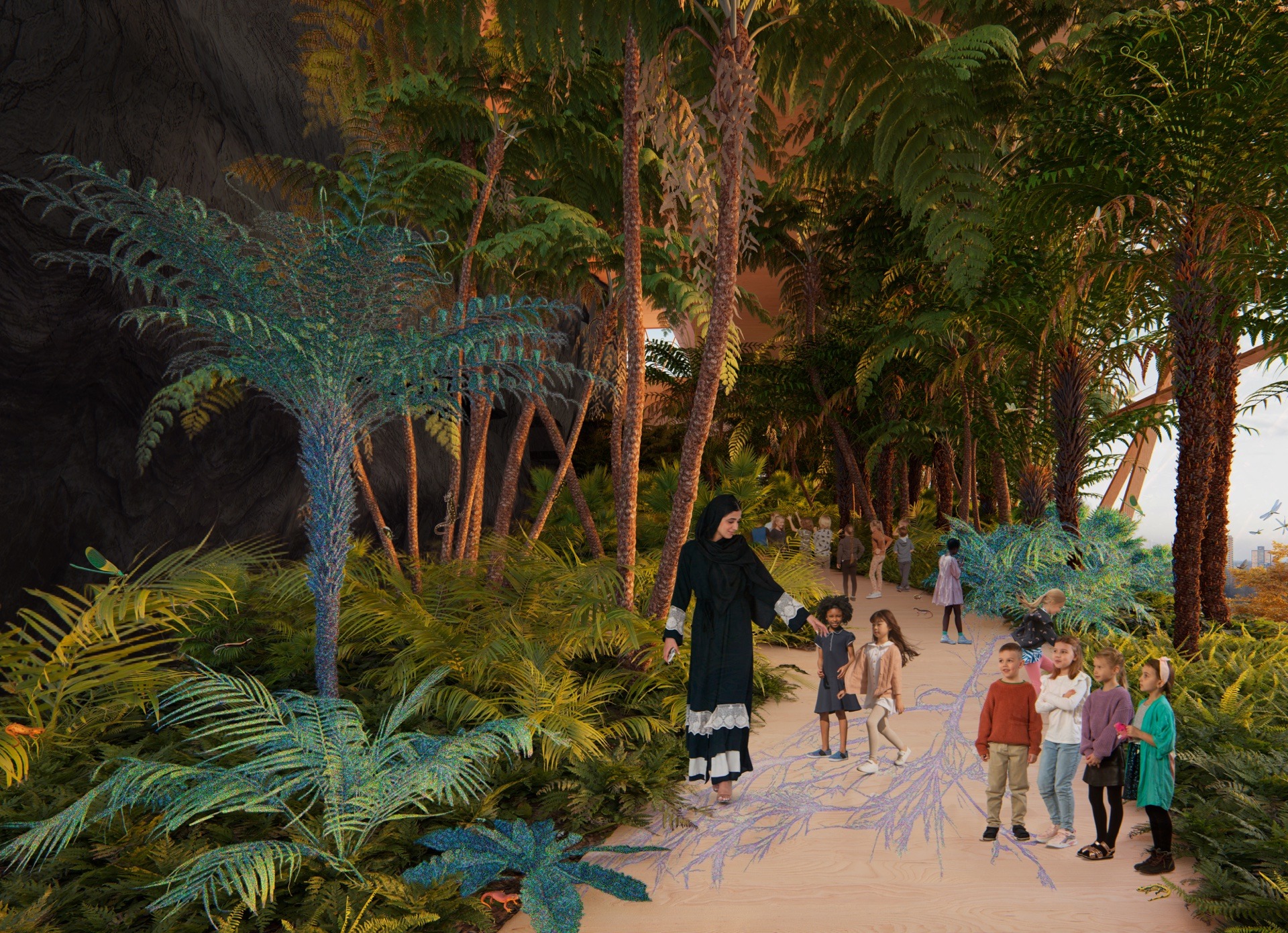
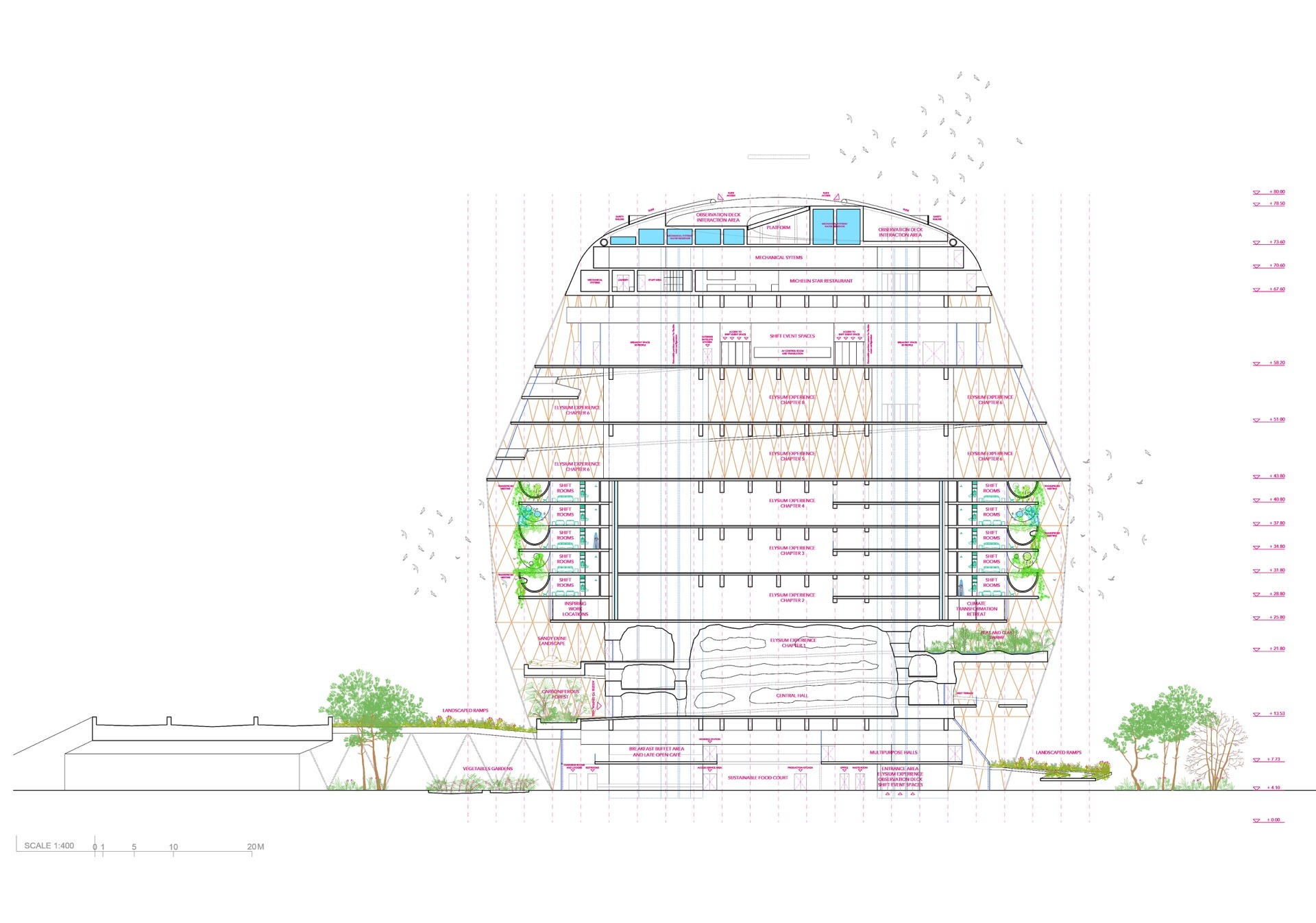
This floating, gardened pathway rises through carboniferous forest ecologies, peat-and-clay wetlands that define the Dutch delta, and dune landscapes that regulate much of the Netherlands’ biodiversity. Along the way, it crosses the geological strata that record Northern Europe’s long history of carbonization and carbon sequestration. What is usually invisible—the deep structure of land, water, and life that produces climate—becomes tangible in everyday life.
Rather than ending in a building, the pathway becomes the building itself. The project is a vertical public park: open, accessible, and continuously used. Climate is not encountered behind doors or screens, but through walking, resting, meeting, and moving together.
This is not a climate Disneyland designed for a single visit. It is conceived as a park rather than a museum—a place embedded in daily routines, where learning happens through repetition and familiarity. The evidence is clear: urban parks attract far larger and more recurrent publics than museums. Central Park receives over 40 million visitors annually; the High Line around 8 million. In Amsterdam, Vondelpark welcomes approximately 10 million visitors each year, compared with 2.7 million for the Rijksmuseum and 1.8 million for the Van Gogh Museum. Parks are places people return to, inhabit, and gradually make their own.
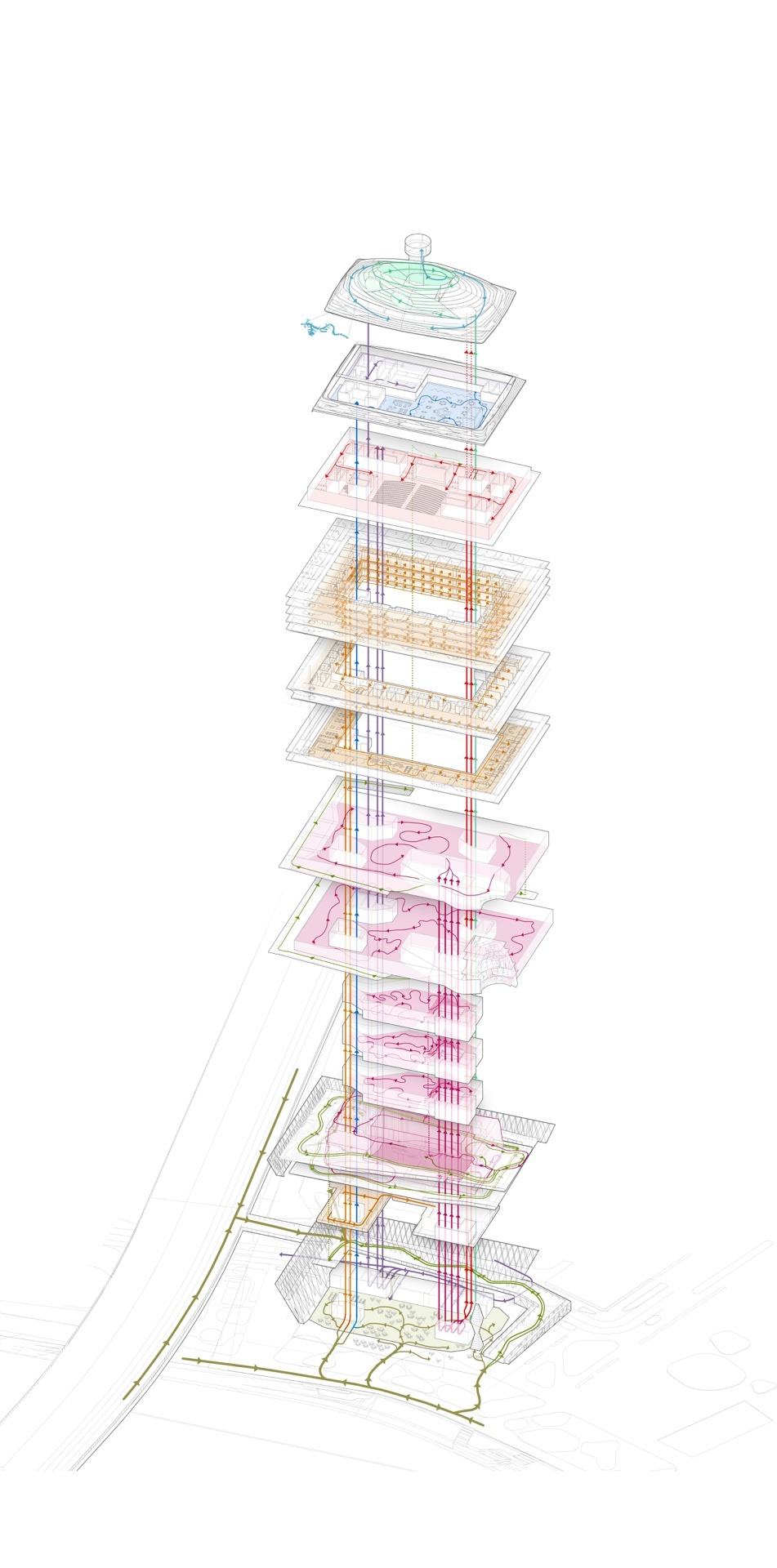
Climate Section builds on this civic logic. It operates as a long-term resource for Rotterdam South and as a destination people will want to revisit from around the world. Conceived as a fully walkable vertical garden promenade (maximum 6% slope), it choreographs an emotional and spatial progression aligned with SHIFT’s ambition: moving from abstraction to tangibility, from observation to engagement, and from engagement to action.
The shared commons of the Climate Section extend and amplify the green landscape of the tidal park, providing access, refuge, and continuity. Climate knowledge is not enclosed within walls; it is opened up as a shared civic environment.
Our ambition is clear: to create the Central Park of the Climate Age—not a black box of exhibits, but a public landscape people inhabit daily, rely on, care for, and keep coming back to—locally and globally.
03 — ABUNDANCE FOR THE COMMUNITY: INVENTING CLIMATE-AGE COMMONALITY
Most buildings still contribute negatively to climate. Some approach neutrality. The Climate Section goes further. In alignment with SHIFT’s vision, it is designed not merely to reduce harm, but to become a generator of climate abundance.
Rather than taking from its surroundings, the Climate Section gives back to the communities it serves. It provides urban connectivity, water retention and wetness, biodiversity, renewable energy, thermal comfort, and shared facilities that improve everyday life in Rotterdam South while actively contributing to climate action. Climate responsibility is not experienced as restriction, but as added value.
Public spaces, shaded routes, climate-controlled commons, and accessible infrastructures support daily use—walking, meeting, resting, celebrating—while quietly performing environmental work. Energy is produced, water is managed, soils are enriched, and ecosystems are supported as part of ordinary civic life.
In doing so, the Climate Section redefines what commonality means in the Climate Age. Not a sacrifice shared reluctantly, but a collective benefit generated together. Climate action becomes a source of comfort, connection, and opportunity—something communities rely on, care for, and proudly inhabit.
04 — WET ABUNDANCE — A SHARED WETNESS FOR ROTTERDAM’S COMMUNITIES
Most buildings are sites of extraction and emission. Some aim for environmental neutrality. Climate Section challenges both models by operating instead as a node of climate empowerment and a generator of eco-social abundance for the communities of Rotterdam South.
The project collects 1.600 m³ of rainfall per year, which—together with the grey water produced throughout the building—circulates through a landscaped system of ramps. As water moves through this vertical landscape, it is filtered by soils, plant roots, and algae integrated into the ramp gardens. Organic matter is removed, water quality is progressively restored, and the system produces water suitable for reuse.
This water is then returned to the community: irrigating vegetable gardens, nourishing surrounding parterres, and sustaining public landscapes. Climate Section thus creates a shared reservoir of wetness, turning water from a risk or waste stream into a collective resource—a cauldron of climatic richness, and both mitigation and adaptation, that supports life, food, and social life across Rotterdam South.
05 — THERMOSOCIAL ABUNDANCE: REDEFINING COMFORT TRHOUGH CLIMATIC GRADIENTS
The Climate Section redefines comfort as a shared and carefully distributed resource, rather than an invisible system that consumes energy indiscriminately. Through the use of geothermal energy, the project creates a climatized public square at ground level that directly serves the surrounding community.
This square hosts cafés and food spaces that extend into low-temperature compost ovens, where cooking becomes both celebration and climate action. It includes heated dance floors, spaces for gathering and birthdays, and a bicycle workshop combined with a biomaterial digital fab lab, where discarded bicycle components are repaired and reassembled into new ones. These everyday activities anchor climate action in pleasure, care, and usefulness. The hospitality functions that support the project’s economic feasibility simultaneously expand their mission by partnering with nearby communities committed to climate-affirming ways of life.
As visitors ascend through the Climate Section, the building is organized around a climatized core, housed within four timber towers, and a peripheral zone where temperature and humidity gradually transition toward hygrothermal conditions that support other forms of life. In these zones, plants, fungi, insects, and microorganisms intensify their entanglement with human activity, making climate gradients perceptible and shared.
In this way, the Climate Section moves beyond the idea of a climate refuge to become a center of thermal redistribution. Energy is not wasted to maintain uniform comfort, but curated and redistributed to support long-term, more-than-human coexistence. Comfort is no longer an entitlement extracted from the environment, but a collective achievement that sustains life across species over time
06- ENERGY ABUNDANCE: COUPLIUNG RENEWABLE PRODUCTION, STORAGE AND USE
The Netherlands is among the world’s leaders in renewable energy integration. In 2024, renewables accounted for over 16% of total energy consumption and 40–50% of electricity generation in the Dutch grid, mostly from offshore wind and solar (Statistics Netherlands, CBS). This success raises a familiar challenge: how to manage periods when wind and solar generation exceed immediate demand.
Today, excess renewable energy is often curtailed — produced but not used — because grids cannot always absorb sudden peaks. Rather than letting this potential go to waste, the Climate Section proposes a thermal energy storage strategy that uses surplus electricity to freeze water into ice as a form of energy accumulation.
This process is grounded in established physical principles:
– Phase-change thermal storage is an efficient way to store energy, capturing the latent heat of fusion (the energy absorbed or released when water freezes or melts).
– Water stores about 334 kJ/kg during freezing/melting — meaning one ton of ice stores ≈ 93 kWh of cooling energy.
At times of peak wind or solar output, surplus electricity is directed to a refrigeration system integrated with the building’s energy systems to produce and store ice in the form of artificially managed glacier, that not only provides energy management opportunities but also brinngs visibility to the instrinsec inseparability of energy and the planetary dimensions of climate making. This ice acts as a thermal battery. When demand increases or renewable generation dips, the stored ice melts gradually, releasing cooling capacity that supports the Climate Section’s thermal comfort systems — e.g., passive cooling of public spaces, night-time ventilation, or temperature regulation of social commons.
In this way, renewable peaks are converted into usable thermal energy, reducing reliance on grid electricity during demand spikes and increasing overall system efficiency. The thermal storage does not replace electrical storage technologies like batteries, but complements them by addressing the specific challenge of seasonal and diurnal mismatches between renewable production and human thermal needs.
By coupling Dutch renewable abundance with on-site thermal storage, the Climate Section becomes not just a consumer of clean energy but a stabilizing partner in the energy system — demonstrating how built environments can help buffer grids, reduce waste, and translate peaks of production into everyday comfort.
07 — ABUNDANCE OF FERTILITY: THE MATERIAL COMMONALITY
The Climate Section pushes the idea of material circularity to its most radical and productive potential. Matter is not treated as waste to be removed, but as a shared resource continuously transformed into soil. Soil-making becomes a central civic process and a source of collective abundance.
Across the building’s gardens, kitchens, and sanitary systems, organic matter is systematically collected and reassembled. Plant residues from gardens, organic waste from food preparation, and black water from the Shift Rooms are directed into an algae-based biodigestion system integrated into the façade. Through controlled microbial processes, this system safely transforms organic matter into nutrient-rich fertilizer.
This fertilizer then cascades through the building, much like a river carries sediments, nourishing the ground-floor vegetable gardens, the vertical landscapes of the Climate Section, and the surrounding public green spaces. What is usually hidden—wastewater treatment, decomposition, nutrient cycling—becomes an explicit, legible process at the heart of the Landmark.
In this way, the Climate Section operates as a cauldron of fertility, radiating life beyond its footprint. Fertility is no longer privatized or exported elsewhere, but produced, shared, and reinvested locally. Material cycles that typically fragment cities are reconnected, turning everyday human activity into a driver of biodiversity, soil regeneration, and food production.
Fertility becomes a material commonality—a shared condition that binds communities, ecosystems, and infrastructures together, and demonstrates how climate action can be rooted literally in the ground beneath our feet.
08 — TRANSSPECIES ABUNDANCE: SHIFT ROOMS AS A RADICAL PLACE FOR MORE-THAN-HUMAN NESTING
From its foundations to its highest point, the Climate Section operates as an infrastructure for transspecies collaboration. It is not conceived as a space for human-only inhabitation, but as an environment where different forms of life actively support one another. The hotel—Shift Rooms—is one of the project’s most explicit expressions of this ambition.
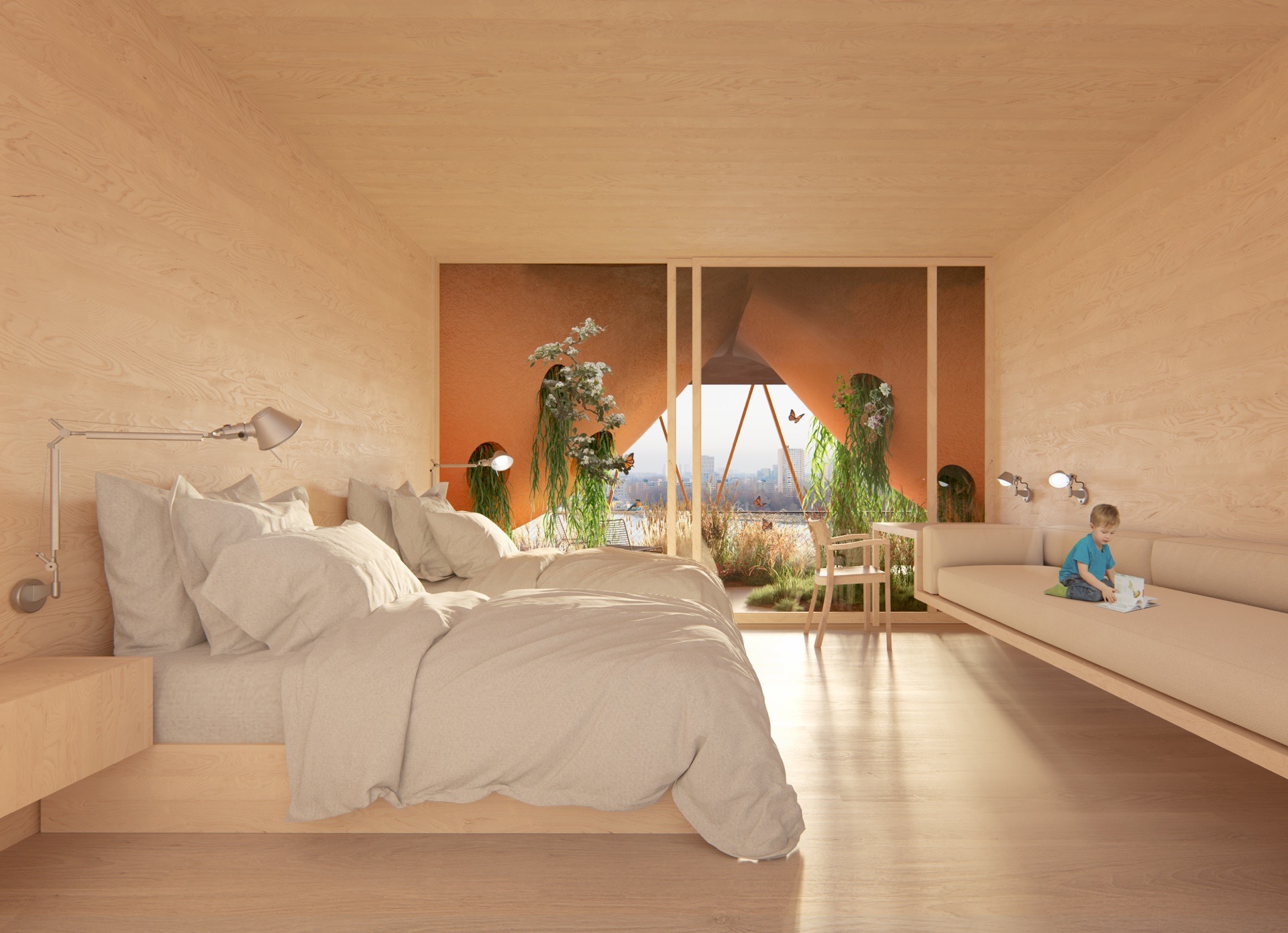
Shift Rooms redefine hospitality as a shared infrastructure for human and more-than-human life. Rather than isolating comfort from ecology, the hotel is designed as a place where diverse forms of life coexist, interact, and thrive together. Staying overnight becomes not only accommodation, but a direct participation in climate repair.
The external envelope of the hotel is crowned by a sequence of large-scale ceramic amphoras. These vessels receive recycled greywater from the hotel’s showers and redistribute it through gravity, evaporation, and capillary action. As the water descends, it generates gradients of humidity, temperature, and nutrient concentration, allowing different plant species, mosses, lichens, and fungi to colonize the surface. What begins as wastewater is transformed into a life-supporting system.
These gradients attract insects, birds, and pollinators, turning the hotel façade into a vertical nesting and feeding habitat. The amphoras operate simultaneously as water treatment devices, microclimate regulators, and ecological infrastructure, making visible how everyday human activities—washing, resting, inhabiting—can directly contribute to the regeneration of biodiversity.
Shift Rooms are not sealed capsules, but porous environments. Air, moisture, microorganisms, and seeds circulate through them. Guests do not simply occupy a room; they become part of an ecosystem in motion, one that reframes hospitality as mutual care across species.
In this sense, the hotel is not an accessory to the Climate Section, but one of its most radical propositions: a place where climate action is not explained, but lived—especially at night, when the city slows down and interdependence becomes tangible.
09 — NO BLACK BOX: LIVING AS INTERFACE
To ensure that immersion becomes a meaningful driver of transformation, the Climate Section deliberately avoids the logic of the black box—closed rooms, predetermined audiovisual scripts, and passive spectatorship. Climate is not mediated through spectacle, but encountered through direct presence.
The immersive experience is built instead around the actual elements that produce climate: landscapes, infrastructures, soils, water systems, and microbial ecosystems. These are not simulated; they are there, operating in real time. Their presence is carefully enhanced through individual and integrated augmented-reality tools, which add layers of narrative, interpretation, and emotional resonance without detaching visitors from their surroundings.
Augmented reality is used not to replace reality, but to thicken it—to reveal hidden processes, long temporalities, and invisible relations that shape climate, while allowing each visitor to navigate their own path through the experience. Physical space and digital layers are woven into a single, continuous interface.
In this way, the Climate Section integrates multiple layers of reality into one experience that reconnects visitors to the world around them, rather than isolating them from it. Immersion becomes an active condition: a way of understanding oneself as part of ongoing climate processes, and of engaging them in a mode of action rather than observation.
The result is not a spectacle to be consumed, but a living interface—one that supports awareness, attachment, and responsibility, and turns experience itself into a catalyst for climate action.
10 — AUGMENTED GEOLOGICAL STRATA: FROM CARBONIFEROUS FORESTS TO DUNES
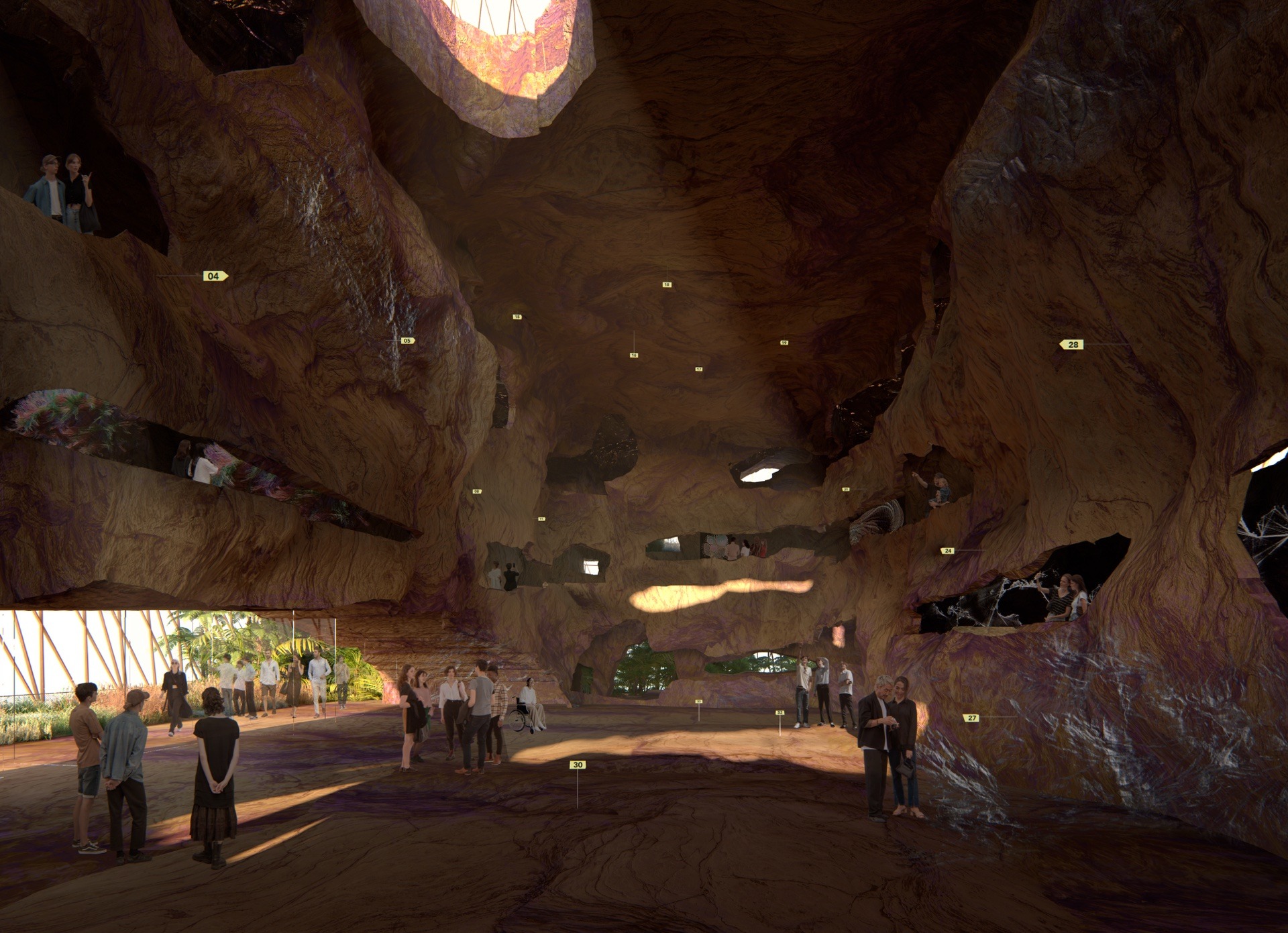
At the core of the Climate Section’s immersive experience is an inhabitable section of Rotterdam’s geological history, designed to make the deep time of climate legible, bodily, and present. This living stratum allows visitors to understand how the current climate crisis is rooted in the release of carbon accumulated over hundreds of millions of years, originally captured by ancient carboniferous forests and later transformed into fossil fuels.
Moving through this geological layer makes tangible the central question of climate change: what happens when carbon is transferred from living systems and soils into the atmosphere—and what it takes to move it back. Rather than explaining this process abstractly, the Climate Section allows it to be felt and experienced, revealing the energetic, biological, and material consequences of carbon circulation.
The presence of carboniferous forest ecologies, together with associated insects and microbial life, turns geological history into a sensed reality. What is often presented as distant data becomes an embodied encounter that reshapes how visitors understand their relationship to the world.
Above this layer, visitors enter the coastal ecologies of peat and clay—the soils that form the climatic belt from which much of Northern Europe’s landscape has emerged. These strata reveal how water, sediment, vegetation, and human intervention interact to produce fertile ground and climatic stability.
Ascending further, a garden of dunes introduces the erosional ecologies shaped by wind and mineral transport. Here, visitors experience how particles travel through the air from distant mountains to coastal landscapes, influencing both climate regulation and biodiversity.
Together, these layers form a living geological section in which abstraction becomes lived experience. The Climate Section does not only address distant visitors, but becomes an everyday infrastructure for the communities of Rotterdam South—allowing their daily lives to be connected to planetary processes and deep time, and turning the city itself into a place where climate is understood, inhabited, and acted upon.
11 — CHAMBER OF PLEDGE: COMMITTING IN FRONT OF OTHERS
The Chamber of Pledge is a space for public commitment—a parliament of individual engagement with climate action. It marks the culmination of the SHIFT emotional arc, where personal reflection becomes a collective declaration.
Here, visitors are invited to make a conscious decision to act. By entering a small recording cabin, individuals articulate a commitment—large or small—to engage with climate action in their own lives, professions, or communities. These pledges are not symbolic gestures, but spoken intentions, expressed in the presence of others.
Each testimony is then shared beyond the building, broadcast through SHIFT’s media platforms and app, and simultaneously made visible within the Climate Section. Bubble-like screens facing the promenade and the tidal park display these messages, allowing passersby to witness a constantly evolving chorus of commitments.
The Chamber of Pledge transforms climate action from a private concern into a shared civic act. Speaking out becomes an act of responsibility, visibility, and mutual encouragement. Commitment is no longer isolated or anonymous, but held in common, reinforcing the idea that climate action gains strength when it is declared, witnessed, and supported by others.
In this space, the Climate Section becomes not only a place of experience, but a place of resolve —where individual intentions are woven into a collective momentum for change.
12 — MICROBIAL CLIMATE: THE INVISIBLE ENGINE OF THE ATMOSPHERE
The top of the Climate Section is dedicated to microbial climate making—the largely invisible ecosystems that regulate planetary conditions. Microorganisms, including bacteria, algae, and fungi, are responsible for roughly 30–50% of the oxygen in Earth’s atmosphere, primarily through photosynthetic processes that remain mostly unseen by humans.
This upper level of the building is conceived as a living microbial landscape. Its surfaces are formed by carefully selected stone substrates with high porosity and mineral diversity, chosen for their capacity to host complex bacterial and fungal communities. In symbiosis, these microorganisms form biofilms that actively interact with air, moisture, and minerals.
Through these interactions, microbial communities can biomineralize carbon—transforming atmospheric CO2 into stable mineral forms such as carbonates. This process, already observed in natural and experimental systems, opens an additional pathway for long-term carbon sequestration that complements forests and soils.
Rather than hiding these processes, the Climate Section makes them legible and inhabitable. Visitors encounter climate regulation not as distant data, but as a living, ongoing activity taking place beneath their feet and around them. By foregrounding microbial life, the Climate Section reveals a fundamental truth of the Climate Age: that planetary stability depends not only on what humans build, but on the microscopic alliances that quietly sustain the atmosphere itself.
13 — KIDS ARE THE CLIMATE FUTURE: LET’S SLIDE THROUGH
The Climate Section is designed as a place where children are allowed to play, test, improvise, and misbehave. Rather than forcing learning through instructions or explanations, the project treats climate as something to be discovered through the body.
For kids, the Climate Section works first as a playground and a park. It is a space to run, climb, explore, imagine, and experiment freely. Climate is not delivered as a lesson, but as an environment that responds to curiosity and movement. Learning happens through repetition, surprise, and joy.
This approach is made explicit at the top of the Section, where a system of large slides offers a fast, physical way back down. Sliding becomes a direct experience of how gravity, energy, ice, and water are connected. What might otherwise be abstract—energy transfer, force, flow—is felt immediately, with laughter and speed.
By turning climate processes into playable experiences, the Climate Section recognizes that children do not learn climate by being told what to do, but by living it. The project makes room for freedom, risk, and imagination—because the future of climate action depends on generations who have grown up feeling at home within the systems they will one day be responsible for navigating.
14 — AN ARGONAUTS TIMBER STRUCTURE FOR MANY POSSIBLE FUTURES
The structure of the Climate Section is conceived as an open system, designed from the outset to accommodate change. Every component is carefully dimensioned so it can be easily adapted, dismantled, and reused, allowing the building to evolve alongside future needs without losing value.
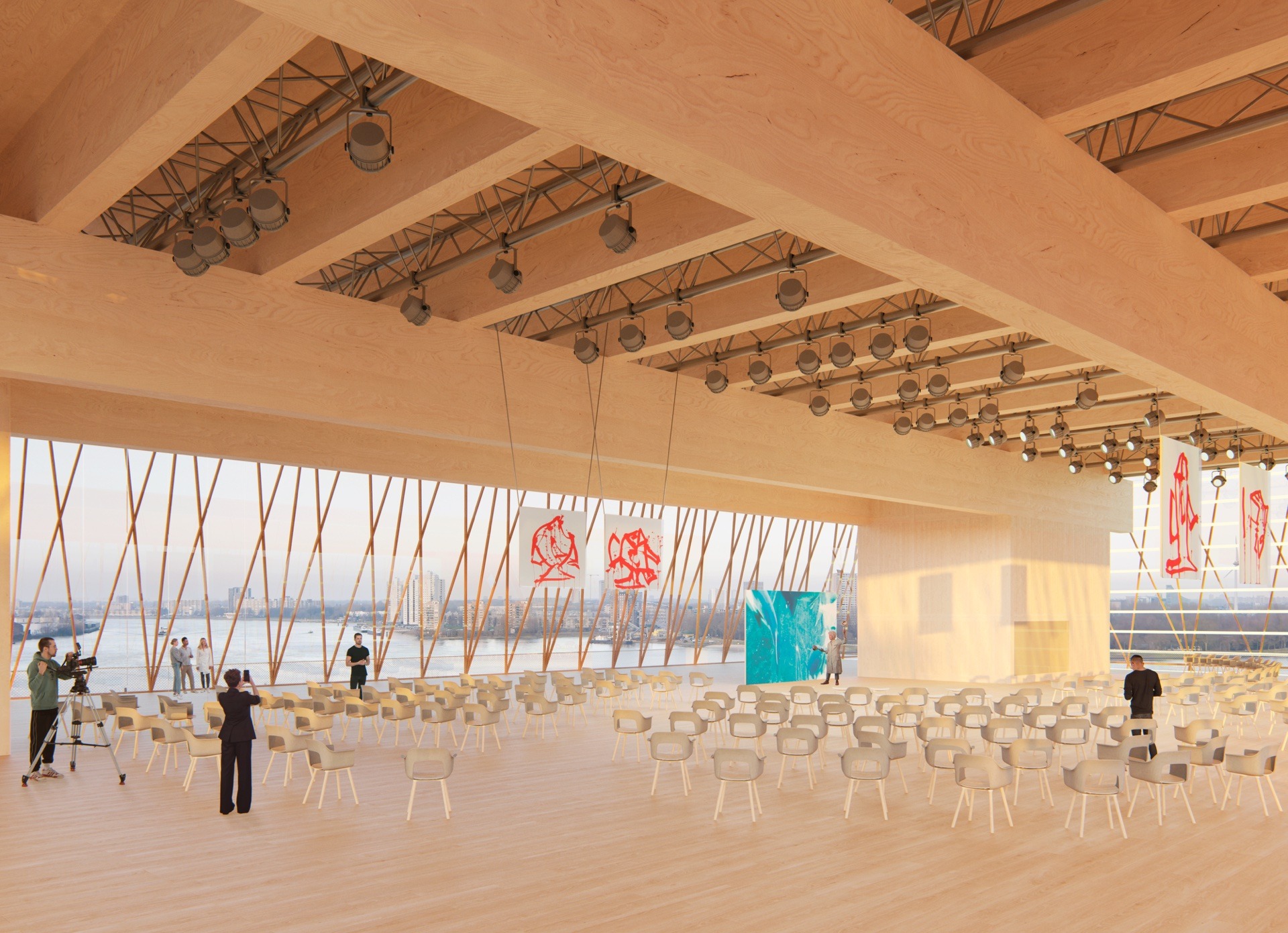
Diversity of use is achieved not through complexity, but through a highly rational and legible structural system. The project is organized as a four-tower timber structure, optimized for construction, use, maintenance, and transformation. This clear structural logic supports an efficient vertical mobility system, enabling a dense and flexible accumulation of simultaneous programs—cultural, civic, commercial, and social—within a compact footprint.
This structural clarity directly reinforces the project’s feasibility and business model. The concentration of vertical circulation and services allows for a high intensity of day-long activities, space rentals, and hospitality uses, providing steady support for SHIFT’s mission without compromising its civic character.
All structural elements avoid idiosyncratic forms or bespoke dimensions. Instead, they rely on standardized, reusable components that can be redeployed in other buildings if parts of the Climate Section are reconfigured or dismantled in the future. The central volumes of the SHIFT Rooms and the House of Transformation are built using modular CLT structures, designed to be relocated and reassembled elsewhere while retaining full functionality.
Ultimately, the Argonauts timber structure demonstrates that simplicity and optionality can coexist with ecological and programmatic complexity. It is an architecture prepared not for a single future, but for many—able to navigate change while remaining structurally, economically, and environmentally resilient.
15 — UP IN-THE-AIR: THE CULMINATION OF A TRANSFORMATIVE EXPERIENCE
The final moment of the Climate Section is designed to be unforgettable—a lived encounter with the atmosphere itself.
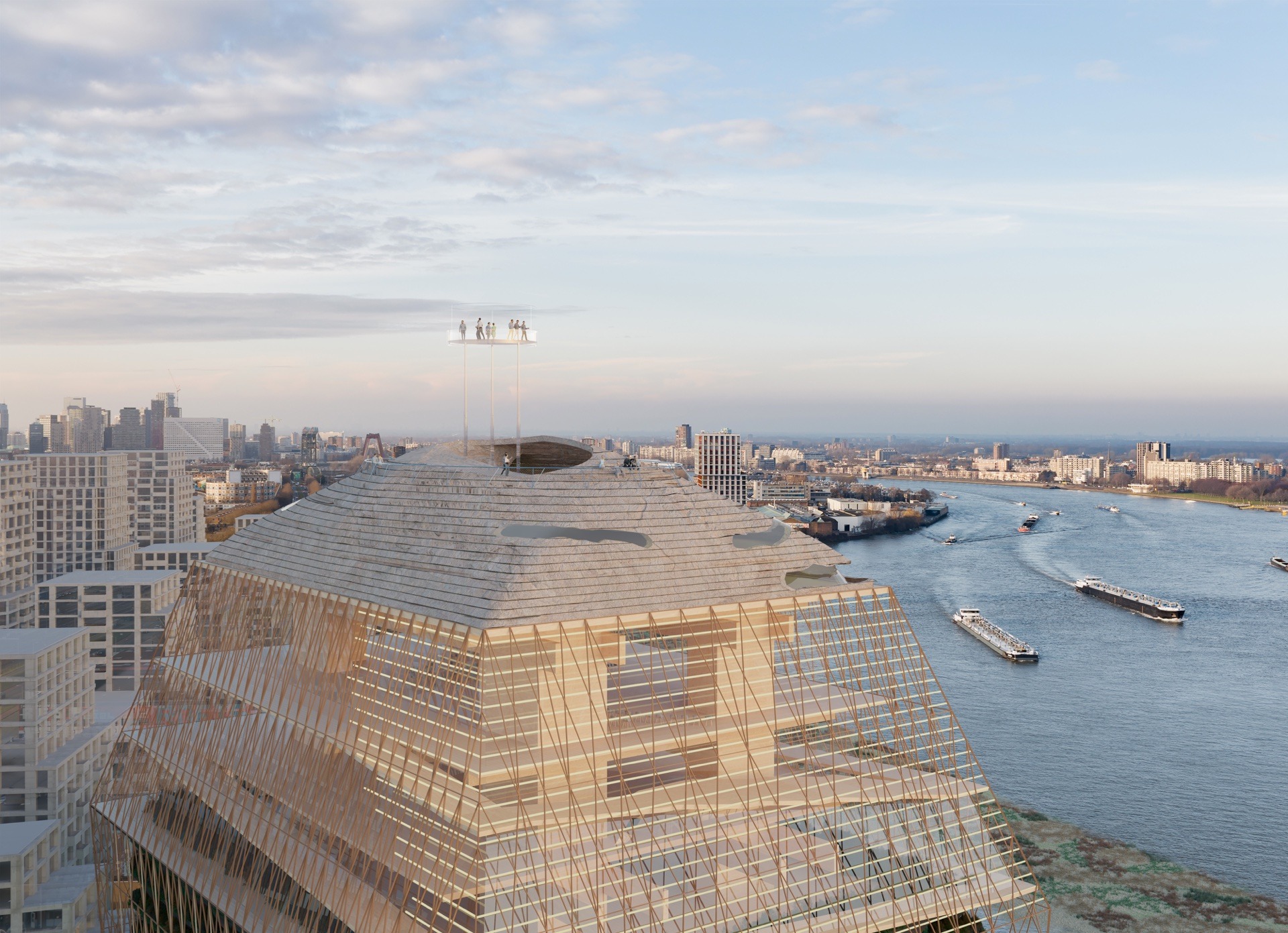
As the last step of the journey, visitors step onto a fully transparent glass platform. Slowly, the platform rises 15 meters above the building, lifting them into the air. Suspended above Rotterdam, with the city unfolding beneath their feet, visitors experience themselves not as observers of climate, but as part of the atmosphere—surrounded by moving air, volatile compounds, suspended particles, pollen, and light.
Time is deliberately given to pause. To breathe. To recognize our airy condition—the fact that life is inseparable from the invisible flows that sustain it.
Then, without spectacle or announcement, a thin crown of glass tubes gently rises around the platform and releases a cloud of seeds from indigenous, climate-remediating plant species. Carried by wind and thermals, the seeds disperse across nearby and distant territories, extending the action beyond the site.
This gesture is not symbolic alone. It is a material act of climate contribution, small in scale but planetary in intention—an offering of regeneration sent into the world.
The moment functions as a secular civic ritual: a shared act that marks commitment without dogma, emotion without spectacle, and responsibility without coercion. It is the coronation of the Climate Section experience—when memory, action, and atmosphere converge into a moment visitors carry with them long after leaving the site.
Credits
Andrés Jaque / Office for Political Innovation
Team Lead
Andrés Jaque / Office for Political Innovation
Roberto González, Elena Beltrán, Jordi Guijarro, Gema Marín, Jesús Meseguer.
Architect of Record
Kaan Architecten (Kees Kaan, Antony Laurijsen)
Structural Engineering
Pieters Bouwtechniek (Jan Versteegen)
MEP and Sustainability
WSP (Eddy van Caulil, Peter Joustra, Mohammed Khan)
Landscape Design
LOLA Landscape Architects (Peter Veenstra, Marit Schavenmaker)
Experience Design
Iart (Steffen Blunk, Lucie Houel, Anna Pfeifer)
Soil and Water Treatment
Envirotecnics (Jochen Scheerer)
Hospitality Advisors
Stadium Consultancy (Christian van Ginneke, Raoul Dumoulin, Ben Veenbrick)
Cost Estimators
IGG Bouweconomie (Marc Hengstmangers, Arno Vonk)
Bio-sinthetic Design
Isabelle Andriessen
Climate, Ecology and Biology Scientific Advisor
David Gruber
Ecological Art
Michael Wang
Fermentation Process
Natalie Schrauwen
Immersive Design
Theo Triantafyllidis
Live-Quantity Visualization
Studio Folder (Marco Ferrari, Elise Hunchuck)
Material Design and Research
Basse Stittgen
Sociopolitical Visualization
Femke Herregraven